
Checking Criminal History in Ellington
Ellington’s official police page is a routing point. Resident troopers and Troop C hold State Police investigation records, G.A. 19 holds filed criminal cases, CT DOC holds current detention data, and SPBI holds official statewide histories. Begin with the kind of record needed and the event’s stage.
- Confirm that an Ellington resident trooper or Troop C handled the event.
- Request the State Police report with the case, date, location, and person details.
- Search Rockville G.A. 19 after prosecutors file a criminal case.
- Use CT DOC’s daily locator if current detention is the question.
- Use CCHRS and SPBI for an official identity-centered self-review.
A recent report can exist before a court docket, and a released person may no longer appear in the daily custody search. Note the date of each check.
Compare results by agency, event date, and docket rather than by name alone. The resident-trooper report describes the police stage; a pending docket shows filed allegations that can still change; DOC reports custody; and SPBI ties reportable events to identity. Keeping those roles separate prevents an Ellington incident from being mistaken for a final conviction or a current custody result from being read as a sentence.
Ellington Resident Trooper Records
Ellington uses resident State Troopers under Troop C. The town police number is 860-875-1522, and the listed fax is 860-870-3152. Troop C is at 1320 Tolland Stage Road in Tolland and can be reached at 860-896-3200 or 800-318-7633. The town has no separate municipal records bureau that replaces DESPP for a State Police investigation copy.
The official Ellington police page provides the local and Troop C contacts and links directly to state investigation-copy and criminal-history channels.
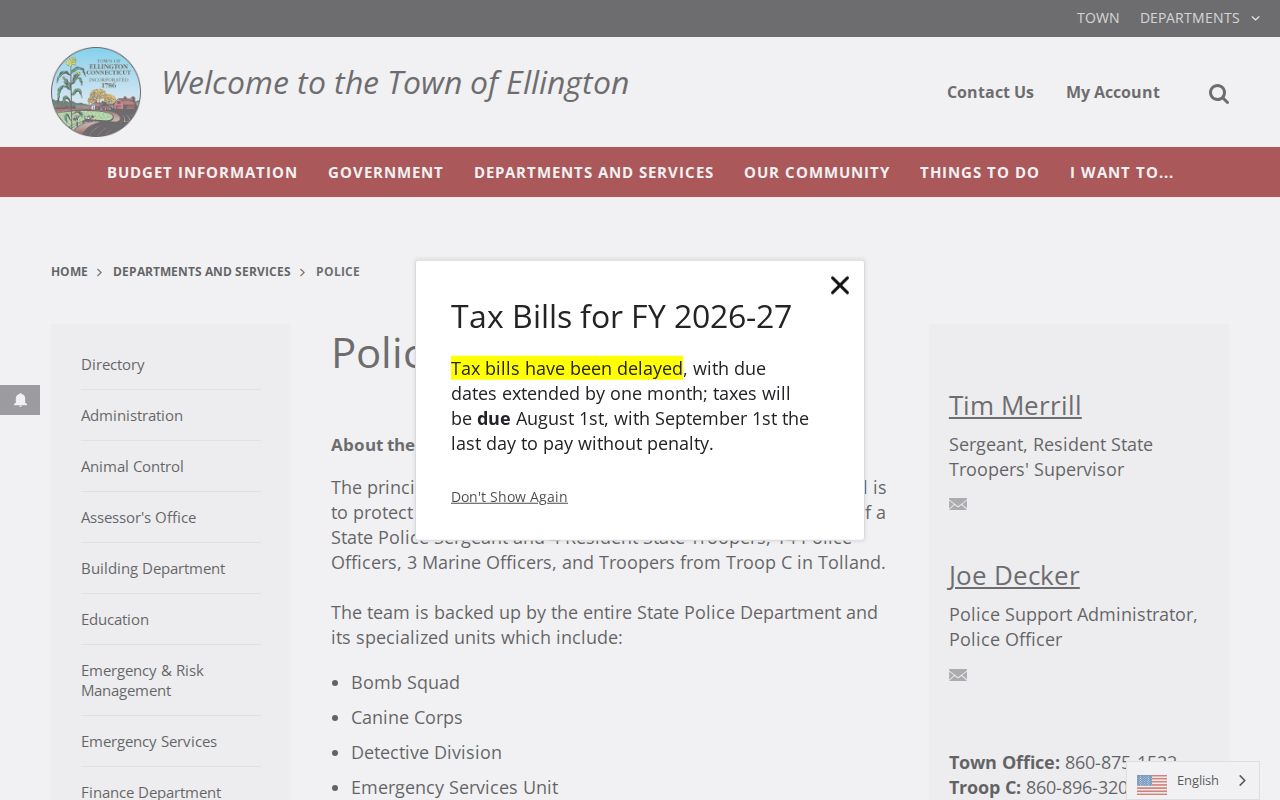
The page’s design mirrors the real system: the town helps users reach the correct State Police service instead of offering a stand-alone Ellington criminal-record portal.
Ellington Police Department Records
The required city police anchor needs a local clarification. “Ellington Police” refers to the resident-trooper service, not an organized municipal department like Vernon Police. Its incident and arrest reports are CSP-created files. Copies normally follow DESPP Reports and Records through GovQA or DPS-96-C, including the statutory nonrefundable $16 search fee. The fee applies whether or not staff locates a record.
A focused request should identify the case number if known, incident date and place, involved person, and the requester’s relationship where relevant. Active investigation, juvenile, protected victim or witness, and confidential-source material may be withheld or redacted. The town phone can help establish the route, but a phone inquiry does not replace the required form or payment.
Keep the GovQA account or request number after submission. The state system may send status notices, clarification requests, an invoice, or a release through the account. A response can include public basic arrest information while protecting narrative or witness content during a pending matter. That partial release reflects Connecticut’s access framework and should not be described as proof that no fuller Ellington investigation exists.
Ellington Record Request Phone Routes
The two main numbers answer different practical needs. Call 860-875-1522 for the Ellington resident-trooper connection. Call Troop C at 860-896-3200 for the regional State Police fallback or guidance when the troop holds the file. The toll-free troop number is 800-318-7633. None of these numbers is a county sheriff line because Tolland County has no sheriff or county records division.
| Town police contact | 860-875-1522 for Ellington resident-trooper service |
|---|---|
| Troop C | 860-896-3200 for regional coverage and records direction |
| Troop C toll-free | 800-318-7633 |
| Report copy | DESPP process using case, date, location, and person details |
When calling, describe the record rather than asking for a general background check. The responder can more readily trace an investigation by event and case identifiers.
Ellington Arrests and Bookings
An Ellington arrest starts with the resident trooper or another State Police unit that documented it. There is no Ellington jail and no county booking roster. If a person remains detained, custody shifts to CT DOC’s unified state system. The locator may label someone “Accused,” and its own warning makes clear that incarceration does not prove conviction.
Prosecutors decide what charges to file, so police allegations can differ from the later G.A. 19 case. A short detention may end before a search, and a court case may not appear until filing. The Tolland County arrest lookup explains the broader timing chain without turning selected CSP press announcements into a complete local blotter.
Requesting an Ellington Investigation
The town page links users to the State Police request for a copy of an investigation. DPS-96-C supports identifying details such as the case number, incident place and date, whether an arrest occurred, arrest date, involved person, role, and available identity information. GovQA supports electronic account delivery, invoices, payment, and status updates for CSP records.
The $16 fee is a search charge, not a guarantee of disclosure. An agency can locate a file and still redact or withhold protected portions. Simple crash records may use an official vendor-linked path, while serious, fatal, certified, or investigative records need the formal DESPP route. A free accident summary covers only a preliminary 30-day window and does not replace the full report.
Ask for the smallest record set that answers the question. A case number and exact date are stronger than a broad name-only request, especially when similar names appear in State Police systems. If the request concerns audio, dispatch, or video, identify the medium as well as the event. The creating agency may apply separate retention, review, and redaction rules to each item.
Municipal Court Records in Ellington
Ellington has no municipal criminal court. Criminal and motor-vehicle prosecutions use Connecticut Superior Court, with local matters generally going to Rockville G.A. 19 at 20 Park Street. The Judicial Branch offers defendant, docket, and court-day searches. A known case that is absent online should be discussed with the clerk, especially when an older conviction, certified disposition, or restricted display rule may be involved.
| Court Name | Connecticut Superior Court, Rockville G.A. 19 |
|---|---|
| Case Types Heard | Criminal and motor-vehicle cases within the G.A. docket |
| Case Lookup Channel | Judicial Branch defendant, docket, and court-day searches; clerk 860-870-3200 |
| What the Docket Shows | Public filed case events, charges, outcomes, and sentence data within scope |
| Copies & Fees | Certified and older records from the clerk; research lists $1 per page |
A police public-record request is not the ordinary route to a certified disposition. Likewise, a court clerk does not use GovQA to decide access to a State Police narrative. If the public portal omits a known Ellington matter, provide the clerk with the T19R docket or identifying information and ask about the court file. Do not infer erasure merely from a web-display omission.
Ellington Criminal Records with T19R
T19R is the Rockville G.A. 19 court code. A full docket number is a stronger search key than a common surname because it combines the court code, case type, year, sequence, and suffix. A defendant search can be narrowed by first initial, birth year or range, and the Rockville court choice. The portal’s accuracy timestamp should be recorded because later filings can change the result.
Online silence has several possible meanings. The prosecution may not be filed yet; the conviction may be outside the web display period; or juvenile, youthful-offender, erased, infraction, or sealed rules may apply. Contact the clerk for a known public case rather than describing a missing result as proof of a clean record. The criminal court case page covers the statewide search choices in depth.
Where Ellington Records Go
The resident trooper creates the police report and records the initial enforcement event. Prosecutors decide what enters the court, and G.A. 19 creates the prosecution docket. Fingerprint-supported information and dispositions report into SPBI. If the person is held, CT DOC creates a custody-centered record.
Record flow: Ellington Resident State Troopers › Connecticut Superior Court, G.A. 19 › DESPP State Police Bureau of Identification
For a new incident, the police route may be the only current source. For a resolved prosecution, the clerk and SPBI answer questions that an arrest report cannot. CT DOC is limited to custody and incarceration history.
Later corrections, pardons, and statutory erasures can alter disclosure. If a fact appears wrong, contact the custodian that owns it: the resident-trooper or State Police records unit for the report, G.A. 19 for case events, DOC for custody, and SPBI for repository history. No Ellington town office can correct all four systems through one request.
Ellington Records in Rural Context
Ellington’s official history and community material emphasize Crystal Lake, Sandy Beach, agriculture, Farm Day, and the farmers market. That setting distinguishes Ellington from Mansfield’s university environment and Vernon’s Rockville court center. It can also make location details important when identifying whether the resident trooper or another State Police unit handled an event.
Local character does not support an invented crime trend. The research found no recent, consistent official crime series for all Tolland County towns. Use a dated town or official UCR report when comparing activity, and never substitute a private ranking for an agency record. The 2020 Census population of 16,426 establishes Ellington’s place in the top-three city-page list, not a claim about public safety.
No Ellington Jail Records
Connecticut unified former county jails and state prisons under CT DOC in 1968. Ellington therefore has no local booking database to search and no sheriff to call. The DOC Inmate Information Search is the right statewide source for current custody, using a DOC number or a combination of name and date of birth.
A current entry can show an accused rather than sentenced status, and daily updates mean rapid release can create a mismatch with a police report. Youthful Offender and ICE-only custody are excluded. For discharged people or added correctional history, the DOC Public Information Office and its FOI process are the documented fallbacks.
Public Access Rules in Ellington
Connecticut FOIA governs State Police executive-agency records but does not make every investigation page public. Disclosure may be limited to protect a pending action, confidential source, unknown witness, signed statement, investigative method, safety, juvenile, or victim information. Agencies should segregate public portions when practical. Court files follow the Judicial Branch’s access and sealing rules instead of the DESPP report system.
Key Statutes:
Connecticut Freedom of Information Act, CGS Chapter 14 - Sections 1-210 and 1-212 set the agency access, exemption, copy, and fee framework.
CGS §1-215 - Basic arrest facts remain public during a pending case even when broader investigative material is protected.
CGS §54-142k - Conviction information is public; nonconviction history is restricted to the subject or authorized attorney.
Ellington’s Direct State Record Links
Ellington’s town police page is especially useful because it links directly to the State Police investigation-copy and criminal-history channels. That design gives residents an honest path through a state-run system instead of implying that the town maintains a complete criminal-history portal. Use the report link for an event-centered investigation and SPBI for an official identity-centered record.
The distinction also protects against overreading a result. A police file can precede a prosecution, a court charge can differ from the arrest allegation, and an SPBI history can change after correction or erasure. The channel should match the question before any conclusion is drawn. Current official copies are stronger than saved search results.