
Checking Criminal History in Mansfield
Build the search around the event. The Mansfield Resident State Trooper office and Troop C handle town policing, but UConn Police is a separate custodian on university property. CSP reports move through the state reports process. Filed charges move to Rockville G.A. 19, present detention moves to CT DOC, and an official identity-centered history belongs to DESPP’s SPBI.
- Use the incident location, case number, or paperwork to identify Mansfield resident troopers, Troop C, or UConn Police.
- Request the incident or arrest report from the agency that created it.
- Search G.A. 19 pending cases or the T19R docket after charges are filed.
- Check CT DOC for current detention, keeping its daily-update warning in mind.
- Use CCHRS and SPBI for an official statewide self-review.
These steps prevent the most common local error: asking the town office for a university file or asking UConn Police for a resident-trooper report.
Preserve the agency and search date with every result. A resident-trooper report, UConn report, pending docket, custody listing, and SPBI history each answer a different question. Similar names alone are not enough to join them. Match case numbers, incident location, birth-year information where lawfully displayed, and the T19R docket before treating records as part of the same Mansfield event.
Mansfield Resident Trooper Records
Mansfield’s police office is in the Audrey P. Beck Municipal Building at 4 South Eagleville Road, Storrs, Connecticut 06268. The local number is 860-429-6024. Official town material describes one sergeant, seven patrol troopers, and an administrative clerk, with at least one resident trooper scheduled at all times. Troop C supplies added patrol and regional support. Calls to the local office can forward to Troop C when the desk is not answered.
The official Mansfield police page presents the resident-trooper contact and town service arrangement.
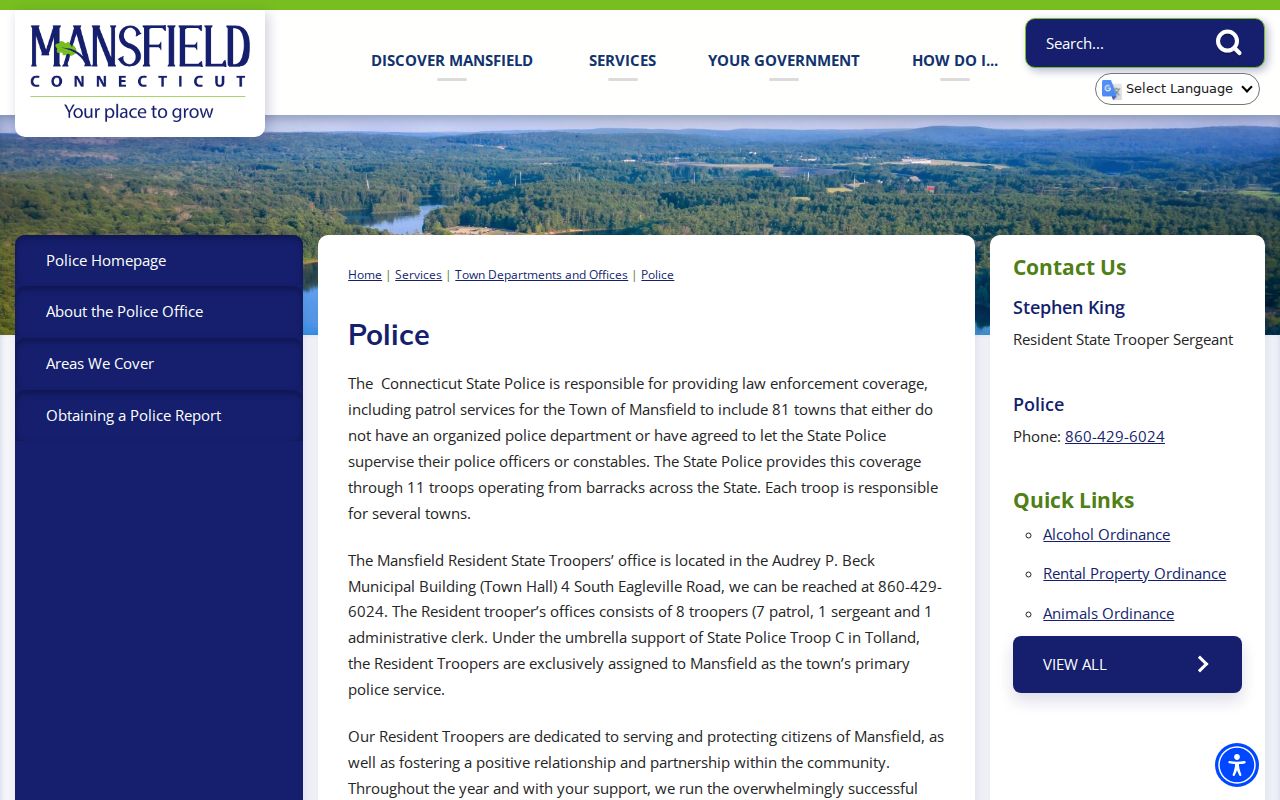
The image reflects a town police doorway into a State Police system, which is why report copies ultimately follow CSP procedures rather than a separate Mansfield police archive.
Mansfield Police Department Records
Mansfield does not operate an independent municipal department like Vernon. Its resident troopers are Connecticut State Police personnel assigned to local coverage. Reports they create follow DESPP Reports and Records rules, including the DPS-96-C form and the nonrefundable $16 statutory search fee for investigation copies. The fee applies even when staff finds no responsive record. GovQA is another active CSP delivery route for report requests, invoices, payments, and electronic updates.
The office can help identify an event, but police@mansfieldct.org is a tips-only address and must not be presented as a report-request mailbox. A request should include the case number if known, incident date and location, involved person, and the exact copy sought. For unanswered local calls, Troop C at 860-896-3200 is the documented fallback.
GovQA account notices can come from an @govqa.us address, so retain the account or request number and check the portal rather than sending duplicate requests. The formal process may produce an invoice, a request for clarification, a partial release, or an exemption explanation. A telephone call can identify the likely custodian, but it does not waive the statutory fee or disclosure review for a Mansfield CSP file.
Mansfield Police Versus UConn Police
Storrs and the UConn campus make Mansfield’s agency boundary unusually important. UConn Police is distinct from the resident-trooper office and Troop C. A university-property incident may therefore create a UConn record even though the mailing address says Mansfield or Storrs. Town roads and neighborhoods generally point toward the resident-trooper system, but the actual report header and case number control.
| Mansfield resident troopers | Town coverage through the State Police resident-trooper program |
|---|---|
| Troop C | Regional and after-hours support; 860-896-3200 |
| UConn Police | Separate agency for university jurisdiction and its own records channel |
| Best identifier | Agency name or case number on the incident paperwork |
If the arresting agency remains unclear, call the local office and describe the location and date. A later court docket may also identify the arresting agency.
Jurisdiction can also affect where related communications, dispatch data, and video are held. Do not assume that one department can release a partner agency’s material simply because officers worked at the same scene. Ask which agency created each requested item. A clear request can name the report, audio, or video separately and allow each Mansfield-area custodian to apply its own retention and access rules.
Mansfield Arrests and Bookings
A Mansfield arrest report remains with the resident trooper, Troop C, or UConn Police, depending on who made the arrest. There is no Mansfield jail and no Tolland County booking log. Detained people enter the unified CT DOC system, which can list both accused and sentenced people. A locator result is therefore a custody record, not proof of conviction.
Timing causes gaps. Someone may be released before the daily locator is checked, while prosecutors may not yet have created a public pending case. Once charges are filed, search G.A. 19 and the T19R docket. For a deeper explanation of the custody and filing sequence, use the Tolland County arrest lookup; for the adjudicated file, use criminal court cases.
Mansfield CrashLogic Report Route
Most Mansfield crash reports use the town’s officially linked CrashLogic channel and are normally available within ten business days, though the town warns that not every report appears there. A missing result does not mean the crash was never documented. Non-crash investigation reports and certified copies follow DPS-96-C through DESPP and carry the $16 search fee.
The official report instructions explain the Mansfield and CSP paths.
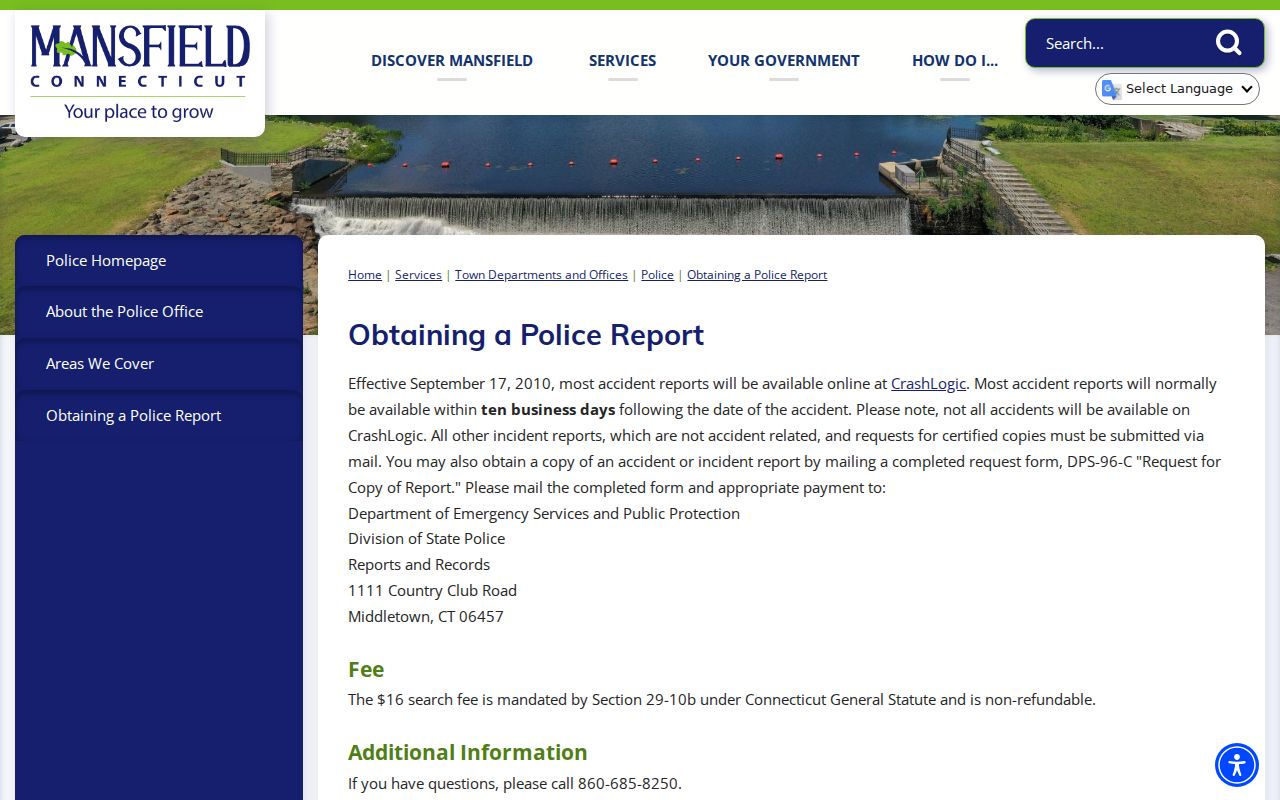
The separate crash and investigation routes shown by the town are important: an online crash product does not replace a certified CSP request or open an active investigative file.
| CrashLogic | Most crash reports; about ten business days; not universal |
|---|---|
| DPS-96-C | Incident and certified CSP reports using case, date, location, and person details |
| Local office | 860-429-6024; unanswered calls may forward |
| Troop C | 860-896-3200 regional fallback |
Municipal Court Records in Mansfield
Mansfield has no municipal criminal court. Connecticut criminal and motor-vehicle prosecutions use Superior Court, with local cases generally routed to Rockville G.A. 19. A town citation or resident-trooper report does not create a Mansfield court docket. Search the Judicial Branch system using the defendant, docket, or court-day route, then ask the G.A. 19 clerk for a certified or older public record.
| Court Name | Connecticut Superior Court, Rockville G.A. 19 |
|---|---|
| Case Types Heard | Local criminal and motor-vehicle prosecutions within the G.A. docket |
| Case Lookup Channel | Judicial defendant, docket, and daily-court searches; clerk at 860-870-3200 |
| What the Docket Shows | Public filed events, charge and disposition information within display rules |
| Copies & Fees | Clerk supplies certified and older files; listed copy rate is $1 per page |
The public portal’s absence is not a final legal conclusion. A recent police referral may not yet be filed, and older convictions can leave the web display under Judicial rules. Juvenile, youthful-offender, erased, and sealed matters have separate limits. When a known Mansfield prosecution is missing, give the G.A. 19 clerk the docket or identifying details and ask about the public case record rather than sending a police FOIA request for a court file.
Mansfield Police Service in Numbers
Mansfield’s official police profile reported 18,304 calls for service in 2020, more than 392 criminal complaints, and 221 motor-vehicle crashes. Those figures are a dated benchmark, not a current crime trend. They do show why the local office, Troop C support, and a distinct crash-report route all matter in a town with university, residential, and rural settings.
The official police-office profile supplies the staffing and service context.
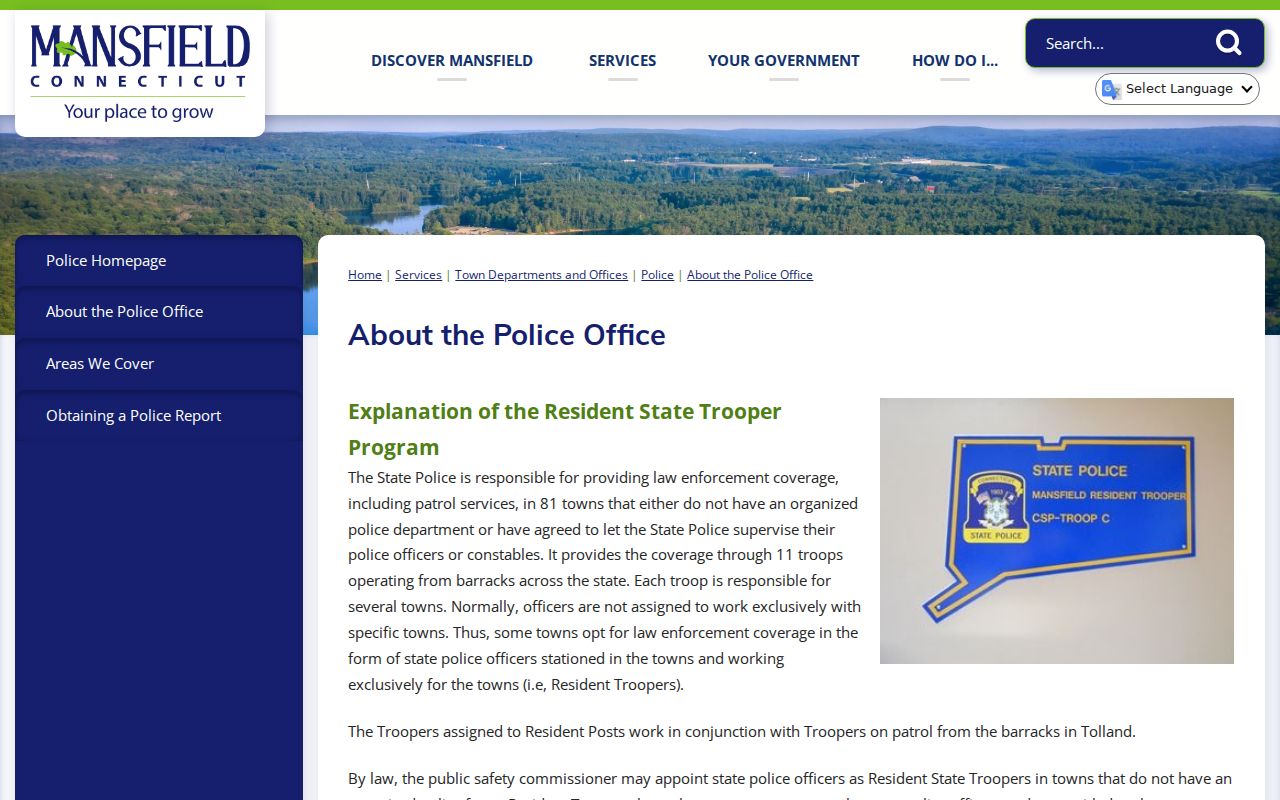
Use these figures to understand the local system’s workload, not to infer guilt, current safety, or a rate for any neighborhood.
Where Mansfield Records Go
Resident-trooper and Troop C reports begin within State Police systems; UConn reports begin with UConn Police. Prosecutors decide what charges to file, and G.A. 19 creates a case-centered docket. Fingerprint-supported criminal-justice information and later outcomes feed SPBI. CT DOC separately records detention.
Record flow: Mansfield Resident State Troopers or UConn Police › Connecticut Superior Court, G.A. 19 › DESPP State Police Bureau of Identification
The sequence explains why an arrest allegation can differ from a filed charge and why an agency report may appear before a court case. Each custodian should be asked for the stage it owns.
Later corrections, dispositions, pardons, and erasures can alter repository or court disclosure. A saved search result can therefore become stale. If one fact appears wrong, contact the office that owns it: the arresting agency for its narrative, G.A. 19 for filed events and outcome, DOC for custody, or SPBI for the official statewide history. That targeted correction path is more useful than asking the Mansfield town office to reconcile every system.
Mansfield Community Policing Context
Mansfield’s official material describes town-gown work, Stuff-A-Cruiser, safety education, Walk to School Wednesdays, and DARE. These programs help distinguish the town’s resident-trooper model from an anonymous regional patrol. They do not create separate criminal-history databases, and participation records should not be confused with incident or arrest files.
For record access, the lasting distinction is jurisdiction. A program led by town resident troopers points to the Mansfield and CSP channels. An event led by UConn Police points to the university department. A filed prosecution still moves to the same Superior Court system regardless of which badge created the initial report.
Mansfield Town-Gown Record Boundaries
A single event can involve more than one Mansfield-area agency, especially when a call begins near campus and moves onto a town road. That does not create one combined public file. Each department can retain the records it created, while the prosecutor and court later build a separate case. Ask the first agency whether another department holds related material, then make a focused request to that custodian.
This boundary also matters for corrections. If an officer’s narrative is disputed, start with the creating police agency. If a charge or disposition appears wrong, contact G.A. 19. If the issue is the statewide identity history, follow SPBI’s correction process. The Mansfield town office cannot alter a UConn, court, DOC, or repository entry simply because the event happened within town borders.
Public Access Rules in Mansfield
CSP and resident-trooper investigation files are executive-agency records under Connecticut access law, but active-case, witness, source, juvenile, victim, technique, and safety exemptions can limit disclosure. The minimum public record of arrest during a pending prosecution is narrower than the full narrative. Court records follow Judicial Branch access and sealing rules, not GovQA. SPBI can disclose conviction information publicly, while nonconviction history is limited to the subject or authorized attorney.
Key Statutes:
Connecticut Freedom of Information Act, CGS Chapter 14 - Sections 1-210 and 1-212 establish access, exemptions, copies, and agency fees.
CGS §1-215 - The public arrest record during a pending case is not the same as the full investigation file.
CGS §54-142k - Convictions are public, while nonconviction history has subject-access limits.
When Mansfield Calls Reach Troop C
A call to the Mansfield office can forward to Troop C when the local desk is unanswered. That is part of the town’s documented coverage model, not proof that the local office is closed or that Troop C owns every file. Give the dispatcher the incident date, location, possible case number, and reason for the records inquiry.
Troop C can help identify a CSP-created report and the correct request path. It cannot turn the tips-only email into a records mailbox, supply a court disposition, or certify that a person has no statewide history. Those products remain with their actual custodians.